Cuban Rumba for Beginners: Guaguancó, Yambú and Columbia
Contents
- Cuban rumba in a few words
- The three main styles
- Yambú: the oldest and slowest
- Guaguancó and the vacunao
- Columbia: fast, solo, and in dialogue with the drum
- The clave: the rhythm underneath
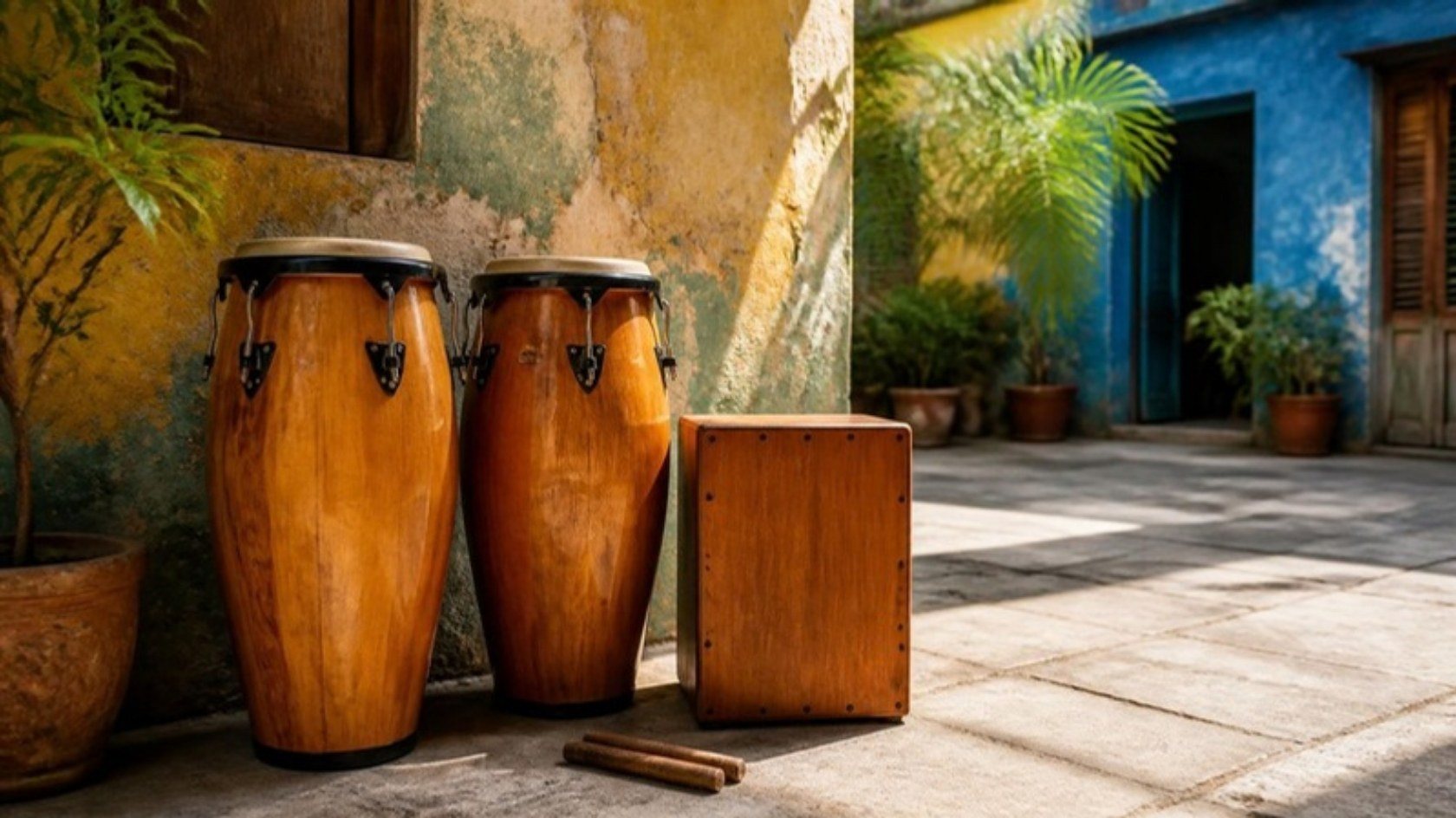
- Cajones and tumbadoras
- How a rumba song unfolds
- Ballroom “rumba” is a different thing
- Rumba’s echo in salsa and timba
- Tips for beginners
- FAQ
- What are the three main styles of Cuban rumba?
- What is the vacunao in guaguancó?
- Is ballroom rumba the same as Cuban rumba?
In short: Wikipedia describes Cuban rumba as “a secular genre of Cuban music involving dance, percussion, and song” that originated “mainly in urban Havana and Matanzas, during the late 19th century.” It says the three traditional forms are yambú, guaguancó and columbia. Yambú “is considered the oldest style of rumba” and has the slowest tempo; guaguancó “is the most popular and influential rumba style,” a couple dance with a playful move called the vacunao; columbia is “a fast and energetic rumba” that is “traditionally meant to be a solo male dance.” Rumba is built on the clave, and Wikipedia says “cajones (wooden boxes) were used as drums until the early 20th century, when they were replaced by tumbadoras (conga drums).” UNESCO inscribed rumba in Cuba on its Representative List in 2016. The “rumba” of ballroom dancing is a different thing.
If you have listened to salsa or son for a while, you may have heard dancers mention “rumba” and wondered which rumba they mean. This post looks at Cuban rumba, its three main styles, and the instruments behind it, in plain English.
Please read this first: I am a curious local in Sapporo, not a musician or a dance instructor, and I am not affiliated with any studio or school. This post organizes what I read in the sources listed at the end. Music history is told in different ways, so if a teacher you trust explains it differently, follow their lead.
Cuban rumba in a few words
Wikipedia’s article “Cuban rumba” opens by calling it “a secular genre of Cuban music involving dance, percussion, and song.” It says rumba “originated in the northern regions of Cuba, mainly in urban Havana and Matanzas, during the late 19th century,” and that it is based on African music and dance traditions, namely Abakuá and yuka, as well as the Spanish-based coros de clave.
Wikipedia’s article “Rumba” adds that “rumba” was originally “used as a synonym for ‘party’ in northern Cuba.”
| Cuban rumba | What the sources say | |
|---|---|---|
| Where it comes from | Mainly urban Havana and Matanzas | Wikipedia, “Cuban rumba” |
| When | Late 19th century | Wikipedia, “Cuban rumba” |
| Roots | Abakuá and yuka traditions, plus the Spanish-based coros de clave | Wikipedia, “Cuban rumba” |
| Three traditional forms | Yambú, guaguancó, and columbia | Wikipedia, “Cuban rumba” and “Rumba” |
| Key components | “Vocal improvisation, elaborate dancing and polyrhythmic drumming” | Wikipedia, “Cuban rumba” |
| Cultural heritage | “Rumba in Cuba, a festive combination of music and dances and all the practices associated,” inscribed in 2016 | UNESCO |
UNESCO’s page says rumba in Cuba involves “verbal and non-verbal forms of communication such as chants, gestures, handclapping, dance and specific body language,” and that it creates “a festive atmosphere.”
The three main styles
Wikipedia says that “traditionally rumba has been classified into three main subgenres: yambú, guaguancó and columbia.” It describes yambú and guaguancó as predominantly urban and “danced by men and women alike,” while columbia “has a primarily rural origin.”
| Style | Tempo and feel | Who dances | What Wikipedia says |
|---|---|---|---|
| Yambú | The slowest tempo of all rumba styles | Alone (usually women) or men and women together | “Considered the oldest style of rumba, originating in colonial times” |
| Guaguancó | Faster than yambú | A couple | “The most popular and influential rumba style” |
| Columbia | “Fast and energetic,” in a triple-pulse structure | Traditionally a solo male dance | Originated “in the hamlets, plantations, and docks where men of African descent worked together” |
Yambú: the oldest and slowest
Wikipedia says yambú is often called “yambú de tiempo España” (yambú of Spanish times). Its dance “incorporates movements feigning frailty.” Male dancers may flirt with female dancers, but “they do not use the vacunao of guaguancó.”
Guaguancó and the vacunao
Wikipedia says guaguancó is “similar to yambú in most aspects, having derived from it, but it has a faster tempo.” The word originally referred to a narrative song style, the coros de guaguancó.
The dance is a playful game between partners. Wikipedia calls it “a couple dance of sexual competition between the male and female.” The man tries to “catch” his partner with a sudden move called the vacunao (‘vaccination’ or ‘injection’), which Wikipedia says can be a thrust of the pelvis or “a sudden gesture made by the hand or foot.” The quinto drum often accents it.
The woman, holding the ends of her skirt, reacts by quickly turning away, bringing the ends of her skirt together, or covering herself with her hand (botao) to block it. Wikipedia notes that “most of the time the male dancer does not succeed in ‘catching’ his partner,” and that “the dance is performed with good-natured humor.”
Columbia: fast, solo, and in dialogue with the drum
Wikipedia describes columbia as being in a triple-pulse (6/8, 12/8) structure, often with a bell pattern struck on a guataca (hoe blade) or a metal bell. According to the Cuban rumba master and historian Gregorio “El Goyo” Hernández, as cited by Wikipedia, columbia originated from the drum patterns and chants of the Abakuá traditions.
The dancer and the lead drum talk to each other. Wikipedia says “columbia quinto phrases correspond directly to accompanying dance steps,” and that the quinto player must switch phrases right away to follow the dancer. It also says men may compete with other men to show agility, strength, confidence, and humor, and that “in recent decades, women are also beginning to dance columbia.”
The clave: the rhythm underneath
Wikipedia’s “Cuban rumba” article says that “rhythmically, rumba is based on the five-stroke guide pattern called clave.” The claves, “two hard wooden sticks that are struck against each other,” are one of the core instruments.
Wikipedia’s article on the clave rhythm adds more detail:
- Rumba clave “is the key pattern used in Cuban rumba.”
- “Both clave patterns are used in rumba.” What we now call son clave “used to be the key pattern played in Havana-style yambú and guaguancó.”
- The 4/4 form of rumba clave is used in yambú and guaguancó, and the triple-pulse form is used in columbia.
My post Salsa Music for Beginners: Clave, Counting, and Listening explains how the clave pattern sounds and how dancers count it.
Cajones and tumbadoras
Here is how Wikipedia describes the drums, in historical order:
- Early proto-rumba: probably played on household items “such as boxes and drawers instead of the congas.”
- Cajones: wooden boxes that “were used as drums until the early 20th century.”
- Tumbadoras (conga drums): they replaced the cajones in the early 20th century.
Today, Wikipedia lists three conga drums as core instruments:
| Drum | Role, according to Wikipedia |
|---|---|
| Quinto | Lead drum, highest-pitched |
| Tres dos | Middle-pitched |
| Tumba or salidor | Lowest-pitched |
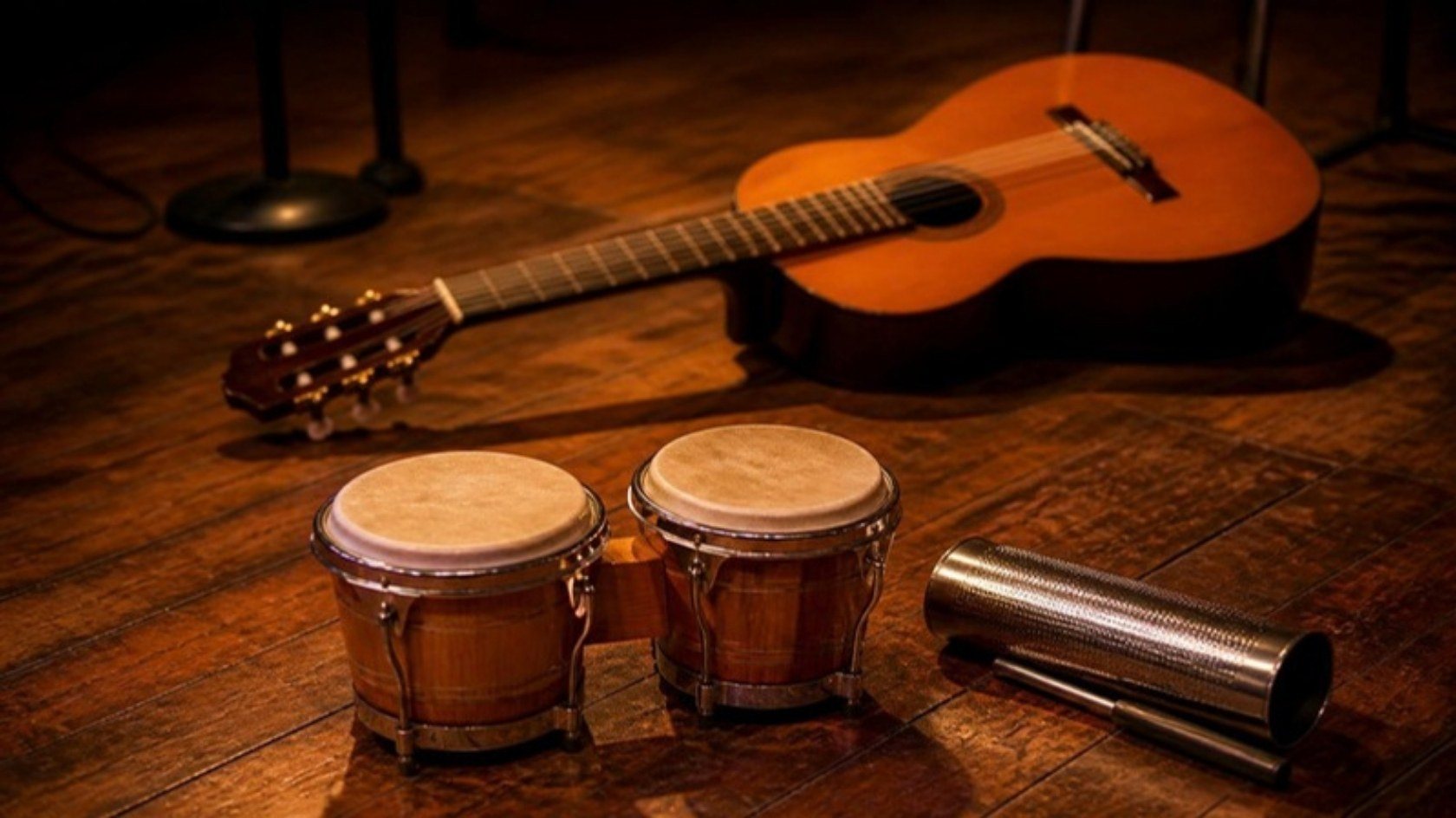
Other common instruments include the catá or guagua (a wooden cylinder struck with sticks called palitos), shakers such as the chekeré and maracas, and bells. Cajones did not disappear: a CD review quoted in Wikipedia’s section on guarapachangueo, a newer style, describes the percussionists Pedro Martínez and Román Díaz “using both cajones (wooden boxes) and tumbadoras (congas).”
How a rumba song unfolds
Wikipedia says yambú and guaguancó songs “often begin with the soloist singing a melody with meaningless syllables,” a part called the diana. Then:
- Canto: the lead singer performs an extended text of verses, sometimes partly improvised. The lead singer usually plays claves.
- Montuno: the lead singer signals the others to repeat a short chorus refrain, in call and response.
Ballroom “rumba” is a different thing
If you have seen “rumba” on a ballroom dance show, that is not Cuban rumba. Wikipedia’s article “Ballroom rumba” says it “appeared in the East Coast of the United States during the 1930s” and combined American big band music with Afro-Cuban rhythms, “primarily the son cubano.” It states: “Although taking its name from the latter, ballroom rumba differs completely from Cuban rumba in both its music and its dance.” Some authors use the spelling “rhumba” to tell them apart.
| Cuban rumba | Ballroom rumba (rhumba) | |
|---|---|---|
| Where it began | Havana and Matanzas, Cuba | The East Coast of the United States |
| When | Late 19th century | 1930s |
| Musical base | Percussion, song, and the clave | American big band music with Afro-Cuban rhythms, primarily son cubano |
| Today | Still “a purely folkloric genre” (Wikipedia, “Rumba”), with three traditional styles and newer ones | Two ballroom styles, American and International (Wikipedia, “Rumba”) |
The “Rumba” article adds that the US “rhumba” music was “mostly inspired by son cubano, while being rhythmically and instrumentally unrelated to Cuban rumba.” My post Son Cubano for Beginners: The Roots of Salsa in Eastern Cuba explains son.
Rumba’s echo in salsa and timba
Wikipedia’s “Cuban rumba” article says rumba’s influence reached genres such as Afro-Cuban jazz and salsa. Wikipedia’s “Rumba” article says that in the 1970s, with the emergence of salsa in the US, “rhythmic elements of Cuban rumba (particularly guaguancó) became prevalent alongside the son.” The “Cuban rumba” article adds that “contemporary timba musicians cite rumba as a primary source of inspiration in composing and arranging.” My post Timba for Beginners: The Sound Behind Cuban Salsa Nights looks at timba.
Tips for beginners
These are my own suggestions, not rules from the sources.
- Hear the three styles side by side. Compare a slow yambú, a guaguancó, and a fast columbia, and notice the tempo change.
- Follow the quinto. Listen for the highest drum and how it answers the singer or the dancer.
- Find the clave. Try tapping the clave pattern along with a rumba recording.
- Ask a teacher about the steps. The sources I checked describe the styles more than the footwork, so a teacher is the best guide for how to dance it.
Cuban rumba grew in Havana and Matanzas from African and Spanish roots, and it lives in three main styles: yambú, guaguancó, and columbia. Next time someone says “rumba” at a Latin night, you will know to ask which one they mean.
FAQ
What are the three main styles of Cuban rumba?
Wikipedia says rumba has traditionally been classified into three main subgenres: yambú, guaguancó, and columbia. It calls yambú “the oldest style of rumba,” guaguancó “the most popular and influential rumba style,” and columbia “a fast and energetic rumba” traditionally danced by a solo man.
What is the vacunao in guaguancó?
Wikipedia describes the vacunao (‘vaccination’ or ‘injection’) as the man’s attempt to “catch” his partner with a sudden move of the pelvis, hand, or foot. The woman blocks it by turning away, closing her skirt, or covering herself with her hand. Wikipedia says the man usually does not succeed and the dance “is performed with good-natured humor.”
Is ballroom rumba the same as Cuban rumba?
No. Wikipedia says ballroom rumba appeared on the US East Coast in the 1930s, based primarily on son cubano, and that it “differs completely from Cuban rumba in both its music and its dance.”
Sources checked: Wikipedia, “Cuban rumba”, Wikipedia, “Rumba”, Wikipedia, “Ballroom rumba”, Wikipedia, “Clave (rhythm)”, UNESCO Intangible Cultural Heritage, “Rumba in Cuba, a festive combination of music and dances and all the practices associated”. Checked on October 8, 2026. Music history is described in different ways by different writers. Corrections are always welcome.