Bachata Music for Beginners: Guitar, Bongo, and the Count
Contents
- Bachata music in a few words
- The instruments of a bachata band
- The guitar: the voice of bachata
- The bongo and the güira: the pulse under your feet
- The three parts of a bachata song
- The count: 1, 2, 3, tap
- How to listen: simple practice at home
- FAQ
- What instruments are used in bachata music?
- Why do bachata dancers tap on 4 and 8?
- How can I find the beat in a bachata song?
In short: bachata music from the Dominican Republic is built around guitars, with a bass, bongos, and a metal scraper called the güira. Dancers usually count it in eights, “1, 2, 3, tap, 5, 6, 7, tap,” with the tap on counts 4 and 8. To find the beat, The Dance Dojo suggests listening for the güira first, because it keeps steady time.
After a bachata class or two, the steps may feel fairly simple, but finding the beat in a real song can be harder. What is that scraping sound? Why does everyone tap on 4? This post looks at the music itself, in plain English.
Please read this first: I am a curious local in Sapporo, not a dance instructor or a musician, and I am not affiliated with any studio or school. This post organizes what I read in the sources listed at the end. Teachers explain music and counting in different ways, so if your class says something different, follow your teacher.
Bachata music in a few words
Wikipedia’s article on bachata music says the genre emerged in the Dominican Republic during the 20th century, drawing on European (mainly Spanish), indigenous Taíno, and African musical elements. According to the same article, before the 1960s the word “bachata” referred to an informal party in the countryside, and the first official bachata songs were recorded in 1962 by José Manuel Calderón, including “Borracho de amor.”
UNESCO added the music and dance of Dominican bachata to its Representative List of the Intangible Cultural Heritage of Humanity in 2019. The UNESCO page describes the music as a fusion of rhythmic bolero with other Afro-Antillean genres, such as son, cha-cha-cha, and merengue, and says the lyrics express feelings of love, passion, and nostalgia.
If you want to compare bachata with salsa in history and feel, my post on salsa music for beginners covers the salsa side, including the clave.
The instruments of a bachata band
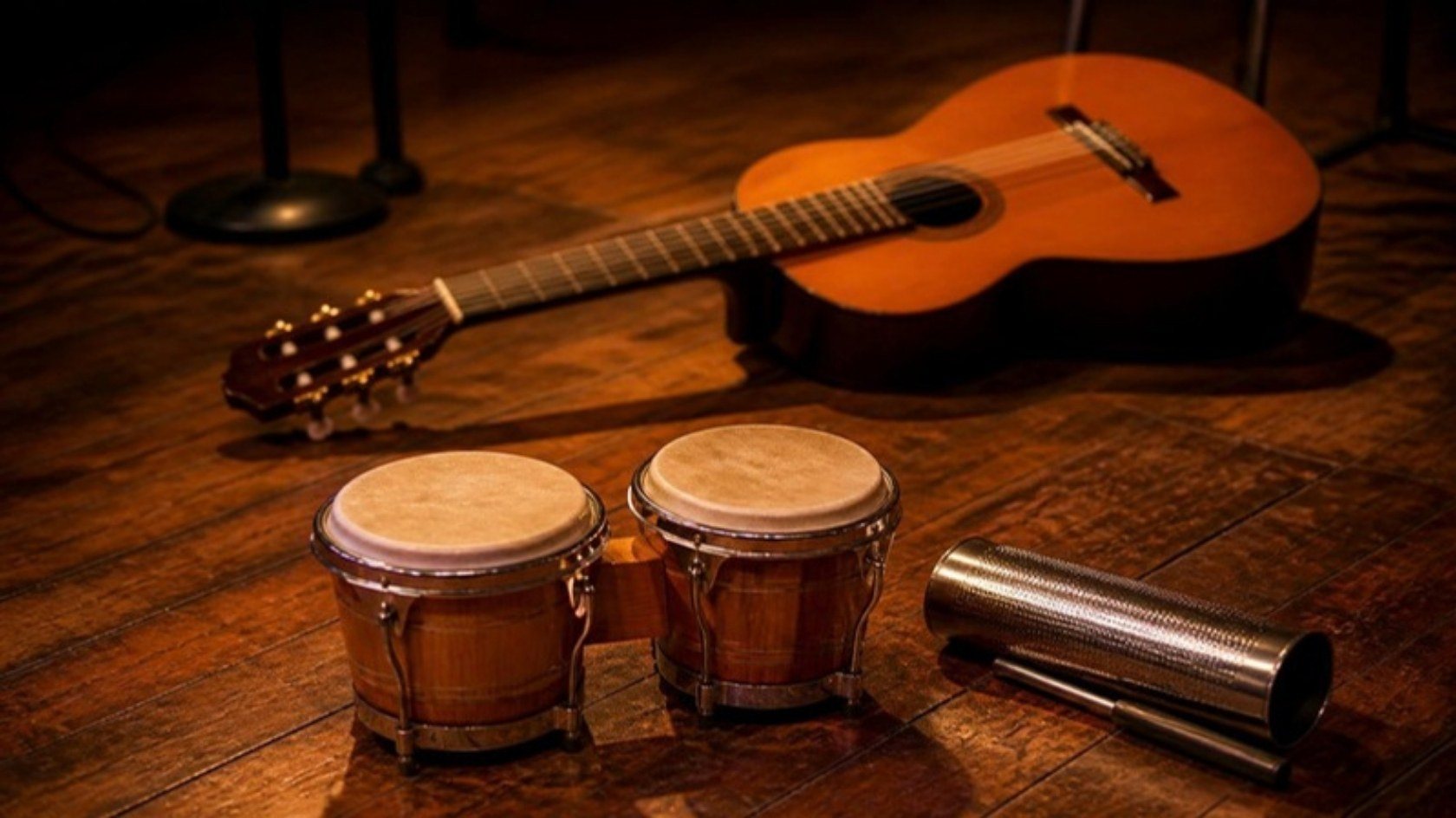
Wikipedia lists five instruments in a typical bachata group. Here is what each one does, based on Wikipedia and a guide to bachata music from The Dance Dojo.
| Instrument | What it does | What the sources say |
|---|---|---|
| Requinto (lead guitar) | Plays the lead lines and melodies | Wikipedia calls its arpeggiated, repetitive chords “a distinctive characteristic of bachata”; The Dance Dojo calls it “the star” |
| Segunda (rhythm guitar) | Backs up the lead guitar | Wikipedia says it adds syncopation; The Dance Dojo says it drives the groove with rhythmic strumming |
| Bass guitar | Plays the low notes | The Dance Dojo says it anchors the beat you step to |
| Bongo | Small hand drums | The Dance Dojo says it adds accents and fills and pushes the energy in the choruses |
| Güira | A metal scraper | The Dance Dojo calls it “your metronome on the dance floor” |
UNESCO’s page lists one or two guitars (often electric today), bongos, maracas, a guiro, and a bass. Wikipedia notes that in the 1980s, bachata changed from maracas to the more versatile güira as it became more dance oriented.
The guitar: the voice of bachata
If one sound tells you a song is bachata, it is often the guitar. Wikipedia describes the requinto’s repetitive, arpeggiated chords as a distinctive feature of the genre, and The Dance Dojo describes its lines as melodic and “crying.”
In my post on bachata styles for beginners, I mention that some guides describe traditional, Dominican bachata as closely tied to the guitar, with the feet following the guitar’s sounds. Listening to the guitar is a good way to connect with that style.
The bongo and the güira: the pulse under your feet
The güira. The Dance Dojo calls the güira the easiest instrument for beginners to lock onto when finding the beat, because it keeps steady time. An article on Soundbrenner’s site describes the güira as supplying a bright metallic subdivision, with near-continuous sixteenth notes. In plain words, it is the fast scraping sound that keeps going under the song.
The bongo. Soundbrenner says the bongo gives bachata much of its conversational feel, and names two ways of playing: derecho, which it describes as steadier, and majao, which it describes as more open.
The three parts of a bachata song
The Dance Dojo uses the same words to describe sections of a song, and adds a third:
- Derecho: the verses. The Dance Dojo describes calm, grounded dancing here.
- Majao: the choruses. The Dance Dojo describes more energy here, with turns.
- Mambo: the instrumental breaks. The Dance Dojo calls this the most energetic part, for footwork and styling.
You don’t need to name these while you dance, but noticing when a song gets calmer or busier can help you match your dancing to it.
The count: 1, 2, 3, tap
Soundbrenner says bachata is in 4/4 time, and that dancers usually feel it as “1, 2, 3, tap, 5, 6, 7, tap,” while musicians count the same thing as two bars of 4/4. The Dance Dojo also describes counting in eights, with the tap landing on 4 and 8.
Wikipedia’s article on bachata dance explains the dance side. It describes an eight-count, side-to-side basic step, with counts 1 to 3 moving one way and counts 5 to 7 moving back. On counts 4 and 8, it says bachata includes a hip movement that gives the dance its look, and that beginners can do it as a tap or a slight lift of the foot. UNESCO also describes the dance as having a simple eight-step structure.
| Count | What your feet do | What to listen for |
|---|---|---|
| 1, 2, 3 | Three steps to one side | The steady güira pulse |
| 4 (tap) | A tap or a slight lift of the foot | The end of the first group of four |
| 5, 6, 7 | Three steps back the other way | The güira, still steady |
| 8 (tap) | A tap or a slight lift of the foot | The end of the eight-count |
One small point from Soundbrenner is worth remembering: the tap on 4 is not late. It stays inside the steady pulse, like every other count. For the step itself, count by count, see my post on the bachata basic step and feeling the rhythm.
How to listen: simple practice at home
These ideas come from the sources above. You can try them with any bachata song.
- Find the güira first. The Dance Dojo suggests the güira as the easiest sound to lock onto. Find the fast scraping sound and count “1, 2, 3, 4” along with the steady pulse.
- Start with slower songs. The Dance Dojo’s test is simple: if you can count out loud without rushing, the speed is right for practice.
- Listen to each instrument in turn. Soundbrenner suggests noticing which instrument keeps the subdivision, which one marks the end of a phrase, and which one creates the most syncopation.
If you want names to search for, Wikipedia mentions Juan Luis Guerra’s album Bachata Rosa and the group Aventura, including the song “Por un segundo.” The Dance Dojo lists artists including Antony Santos, Romeo Santos, and Prince Royce.
Start with the güira, count to eight, and let the guitar carry you. The more you listen, the easier the tap on 4 will feel.
FAQ
What instruments are used in bachata music?
According to Wikipedia, a typical bachata group has a lead guitar (requinto), a rhythm guitar (segunda), a bass guitar, bongos, and a güira. UNESCO’s description also mentions maracas and a guiro, and Wikipedia says bachata changed from maracas to the güira in the 1980s.
Why do bachata dancers tap on 4 and 8?
Bachata is usually counted in eights. Wikipedia’s bachata dance article describes three steps to each side, with a hip movement on counts 4 and 8 that beginners can do as a tap. Soundbrenner describes the dancer’s count as “1, 2, 3, tap, 5, 6, 7, tap,” and The Dance Dojo says the tap lands on 4 and 8.
How can I find the beat in a bachata song?
The Dance Dojo suggests listening for the güira, the metal scraper, because it keeps steady time. Count “1, 2, 3, 4” along with it, and start with slower songs that you can count out loud without rushing.
Sources checked: Wikipedia, “Bachata (music)”, Wikipedia, “Bachata (dance)”, UNESCO, “Music and dance of Dominican bachata”, The Dance Dojo, “Bachata Music: The Instruments, Sound and Songs of Bachata”, Soundbrenner, “Bachata rhythm”. Checked on October 7, 2026. Teaching methods and counting vary by teacher and region. Corrections are always welcome.