How to Practice Salsa at Home Between Classes: Simple Steps
Contents
- Why practice salsa at home between classes?
- Step 1: Listen and count along to salsa music
- Step 2: Practice the salsa basic step in front of a mirror
- Step 3: Keep practice sessions short and repeat often
- Floor, shoes, and space: practice salsa safely at home
- Practicing quietly in an apartment: be kind to your neighbors
- FAQ
- How often should I practice salsa at home?
- Can I practice salsa alone without a partner?
- What shoes should I wear to practice salsa at home?
In short: short, regular practice at home can help you keep what you learned. Listen to salsa music and count along, practice the basic step slowly in front of a mirror, repeat it for a few minutes at a time, and take care with the floor, your shoes, and the sound.
You had a fun salsa class. A week later, at the next class, the steps feel new again. This is very common. Between classes, it is easy to forget the count, the timing, and even which foot starts.
Please read this first: I am a curious local in Sapporo, not a dance instructor. This post is a set of general ideas for practicing alone, based on what I have read. It is not about any particular class, and I am not affiliated with any studio or school. Teachers explain salsa in different ways, so if your class teaches something different, follow your teacher. If practicing causes pain, stop and ask a qualified professional.
Why practice salsa at home between classes?
A class gives you new steps, a teacher’s eye, and partners to dance with. Home practice can’t replace that. But it can help with a few simple things:
- Remembering the count. Saying “1, 2, 3, 5, 6, 7” out loud many times helps it feel natural.
- Getting used to the basic step. The more familiar your feet are with the basic, the more attention you can give to your partner and the music in class.
- Listening. Hearing more salsa music helps you notice the beat and the changes in a song.
You don’t need a big room or special equipment. A small clear space, a music player, and a few minutes are enough to start.
Step 1: Listen and count along to salsa music
For many beginners, the timing can feel harder than the footwork. So a good first step at home is to practice listening without dancing at all.
Salsa music is usually counted in groups of eight, and many classes teach the basic step as 1, 2, 3, (pause), 5, 6, 7, (pause). If you want a refresher on the count, see What Is Salsa?.
Here are some simple listening exercises:
- Clap the steady beat. Put on a salsa song and clap or tap your foot on every beat.
- Count to eight. When the steady beat feels easy, count “1” to “8” out loud, again and again.
- Say the step count. Then switch to “1, 2, 3, … 5, 6, 7, …” and keep quiet on 4 and 8.
- Try a different song. Songs have different speeds. Start with a slower song, then try a faster one.
You can do these on a walk, while cooking, or on the train (counting quietly in your head). For more listening ideas, including the clave rhythm, see Salsa Music for Beginners: Clave, Counting, and Listening.
Step 2: Practice the salsa basic step in front of a mirror
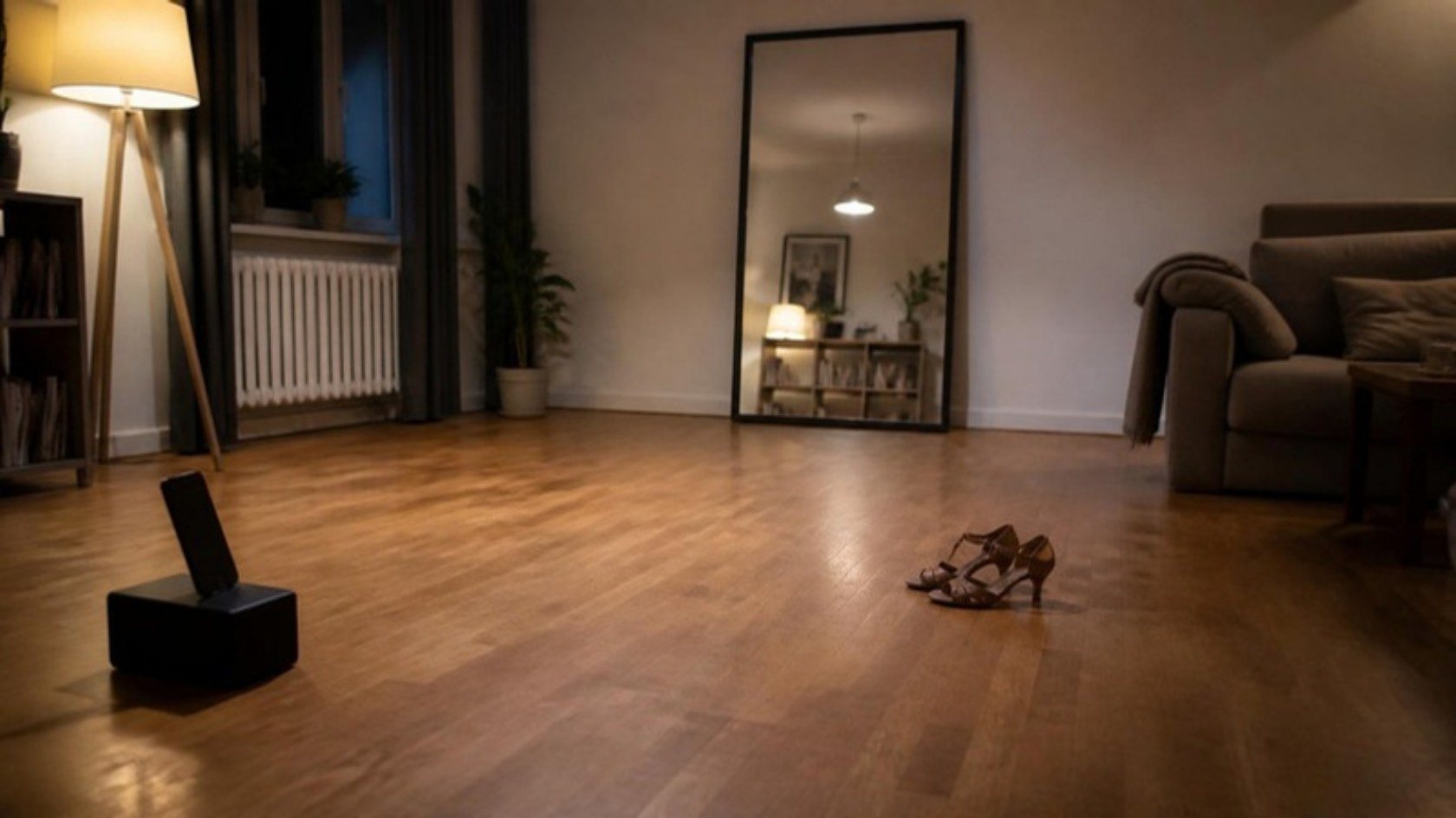
When counting feels easy, try the basic step. A mirror, a dark window, or even your phone’s camera can help you see what your feet and body are doing.
A few things many beginners check in the mirror:
- Step size. Small steps are often easier to keep on time.
- Posture. Stand tall and relaxed, without looking down at your feet all the time.
- Weight. On each step, does your weight really move onto that foot?
- The pause. On 4 and 8, do you hold without taking a step, or do your feet keep stepping?
Start without music, very slowly, saying the count out loud. Then try it with a slow song. If you lose the count, stop, listen for a moment, and start again on “1.” That is normal, and it is part of the practice.
If your class teaches a different version of the basic step, or a side basic instead of a forward-and-back basic, practice the version your teacher showed you.
Step 3: Keep practice sessions short and repeat often
Many people find that short, frequent practice is easier to keep up than one long session. Ten minutes on several days may be easier to fit into your life than one hour on the weekend.
Here is one simple example of a short session. It is only an idea; change it to fit your class and your day.
| Time | What to do | Point to notice |
|---|---|---|
| 2 minutes | Clap and count along to one song | Find the steady beat first |
| 3 minutes | Basic step without music, saying the count | Small steps, clear pause on 4 and 8 |
| 3 minutes | Basic step with a slow song | Stay with the music, not ahead of it |
| 2 minutes | One step or move from your last class | Only one thing at a time |
It can also help to write a short note after each class: the name of a move, the count, and anything your teacher said. Then you know exactly what to practice at home.
Don’t try to practice everything at once. One or two things, done slowly and correctly, are often more useful than many things done in a hurry.
Floor, shoes, and space: practice salsa safely at home
Home floors are not dance floors. A few simple checks can make practice safer and more comfortable:
| Check | What to look for |
|---|---|
| Space | A clear area with no tables, cords, or toys nearby |
| Floor | Not too slippery and not too sticky; take care with loose rugs |
| Shoes | Clean indoor shoes or socks that let you turn without slipping too much; bare feet can stick when you turn |
| Turns | Try turns slowly at first, especially on a slippery floor |
| Rest | Take a break if you feel tired, and drink water |
Socks on a smooth wooden floor can be very slippery, so be careful with turns. Some people keep a pair of clean indoor shoes just for practice. For more about choosing shoes for class, see What to Wear to Your First Salsa Class.
Practicing quietly in an apartment: be kind to your neighbors
In apartments, sound travels. Music and footsteps, especially heels on a hard floor, can be heard downstairs and next door.
A few habits many people use:
- Use headphones for the music.
- Practice in soft shoes or socks, and keep the steps light and small.
- Choose a reasonable time of day, not early in the morning or late at night.
- Put down a mat or rug if you practice in the same spot often, and check that it doesn’t slide.
- Check your building’s rules, if it has any about noise.
Practicing quietly is also a good skill in itself. Light, small steps are often easier to control.
Home practice doesn’t need to be perfect or long. A few minutes of counting and a slow basic step, done often, can make the next class feel a little more familiar. Then, in class, you can enjoy learning the next step with your teacher and partners.
FAQ
How often should I practice salsa at home?
There is no single rule. Many beginners find that short sessions on several days a week are easier to keep up than one long session. Even a few minutes of counting along to music can help between classes.
Can I practice salsa alone without a partner?
Yes. Many beginners practice the count and the basic step alone at home. Partner work, such as leading and following, is easier to learn in class, but practicing alone can help your timing and footwork.
What shoes should I wear to practice salsa at home?
Many people use clean indoor shoes or socks that let them turn without slipping too much. Socks can be very slippery on smooth floors, and bare feet can stick when you turn, so check your floor and try turns slowly.