Cumbia for Beginners: Colombia's Rhythm on the Dance Floor
Contents
In short: cumbia comes from Colombia. SalsaVida says it began along Colombia’s Caribbean coast as a local folk music and dance, around the Magdalena River and coastal towns, during the colonial era. Wikipedia and TeachRock both describe it as a mix of Indigenous, African, and Spanish elements. Over the 20th century it spread beyond Colombia, and Wikipedia lists local styles in countries such as Mexico, Peru, Argentina, Chile, and Ecuador. On the social dance floor, SalsaVida describes a relaxed, rebounding basic that breaks back on the first and fifth beats.
At a Latin social night, between salsa and bachata, you may hear a lighter song with a steady, swinging “chu-chucu-chu” in the background, and couples start circling around each other in small, bouncy steps. That may be cumbia. This post looks at where it comes from and how the basic step feels, in plain English.
Please read this first: I am a curious local in Sapporo, not a dance instructor or a musician, and I am not affiliated with any studio or school. This post organizes what I read in the sources listed at the end. Steps and counting are taught in different ways, so if your class says something different, follow your teacher.
Cumbia in a few words
Wikipedia’s article on cumbia opens by describing it as a number of musical rhythms and folk dance traditions of Latin America, involving elements from Indigenous peoples, Europeans, and Africans during colonial times. So “cumbia” is not one single fixed style, but a family of music and dance.
Its home is Colombia. SalsaVida says cumbia originated along Colombia’s Caribbean coast as a local folk music and dance, in regions around the Magdalena River and coastal towns, during the colonial era. TeachRock, an educational curriculum site, places its roots in the five states of the Caribbean Coast of Colombia, and more specifically on the banks of the Magdalena River.
| Cumbia | What the sources say | |
|---|---|---|
| Where it comes from | Colombia’s Caribbean coast, around the Magdalena River | SalsaVida; TeachRock; Wikipedia (“the coastal region of Colombia”) |
| When it took shape | Colonial era | SalsaVida; Wikipedia |
| Cultural roots | Indigenous, African, and Spanish | Wikipedia; TeachRock; SalsaVida |
| Core sound | Flutes and drums | SalsaVida; Wikipedia |
| Spread | Across Latin America over the 20th century | Wikipedia; SalsaVida |
Three cultures in one rhythm
Wikipedia describes cumbia as having elements of three cultures, American Indigenous, African, and Spanish, as the result of the long meeting of these cultures during the Conquest and the colonial period. TeachRock describes the part each culture played:
- African: TeachRock says enslaved Africans brought the memories of their drums and rhythms, which became the percussive foundation of the music.
- Indigenous: TeachRock credits the Kogui people with the gaita (a flute) and the maracas, along with a kind of whistle.
- Spanish: TeachRock says the colonizers brought the Spanish language and the traditional clothing worn for the dance, such as large skirts and flower headdresses for women, and white shirts, red scarves, and vueltiao hats for men.
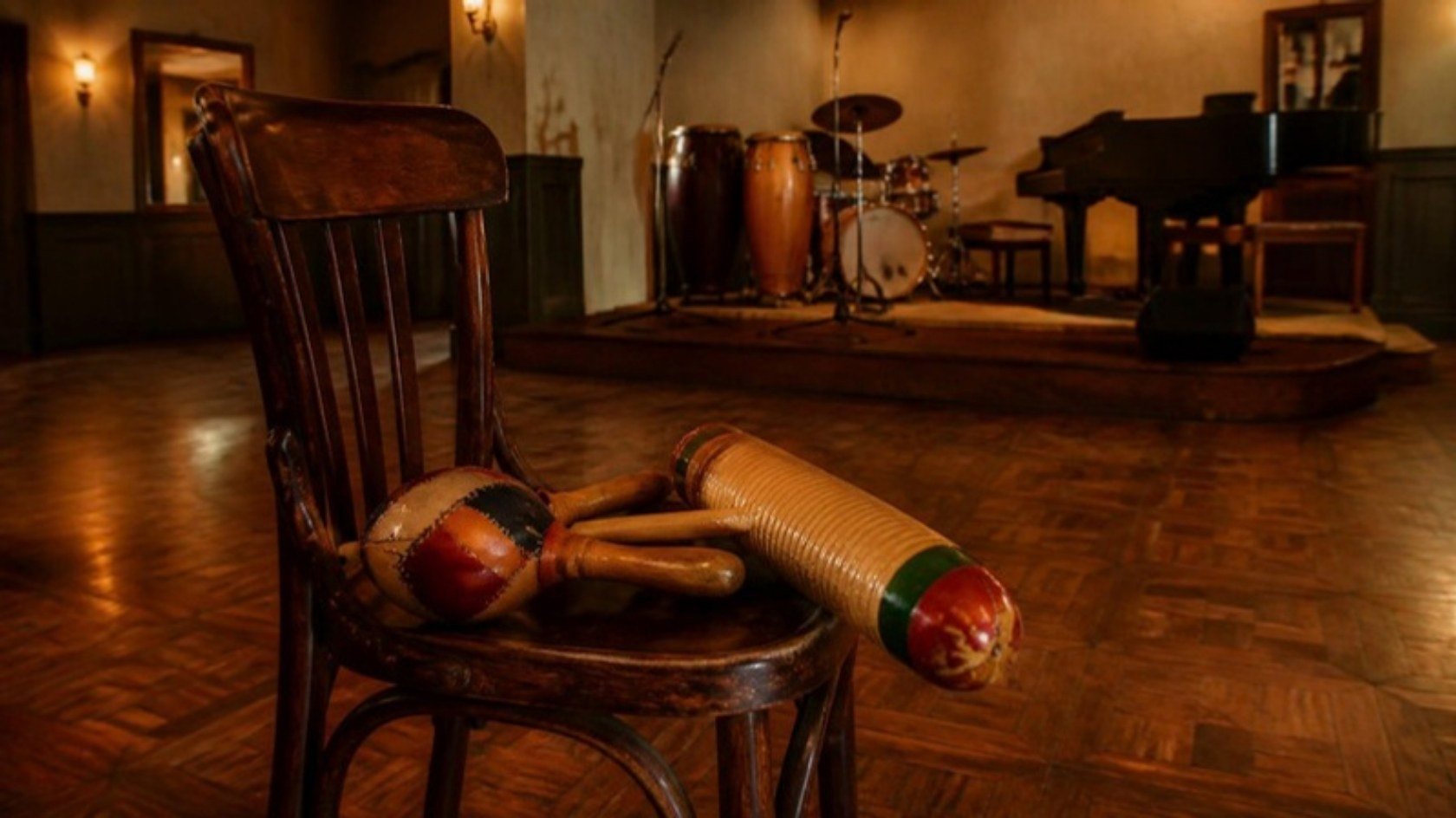
On the instruments, Wikipedia lists three drums (the tambora, the tambor alegre, and the llamador) and flutes such as the gaita hembra, the gaita macho, and the flauta de millo. It also mentions the guacharaca, which creates the simple “chu-chucu-chu” rhythm. SalsaVida sums up the sound as flutes and drums at its core.
SalsaVida also notes that the word “cumbia” is linked to “cumbé,” a term associated with Afro-descendant dances and rhythms from the Bantu linguistic area.
From the Colombian coast to the rest of Latin America
The sources describe cumbia moving from a regional folk tradition to a much wider audience during the 20th century.
- Big bands in Colombia. SalsaVida says that in the 1940s and 1950s, bandleaders arranged cumbia for big orchestras, which helped make it one of Colombia’s most recognized musical exports. TeachRock names the composer Lucho Bermúdez, who in the 1940s combined the Afro-Colombian rhythms of cumbia with the format of a big band.
- Beyond Colombia. Wikipedia says that over the 20th century, cumbia expanded beyond Colombia through migration, media, and musical exchange across borders. It describes regional versions in countries including Argentina, Bolivia, Chile, Ecuador, Mexico, Panama, and Peru.
- Local styles. SalsaVida mentions Mexican cumbia and Peruvian cumbia, including the psychedelic style called “chicha.” Wikipedia says that in Mexico, cumbia developed into several sub-genres and became a cornerstone of urban popular culture.
TeachRock adds that recent Colombian artists such as Carlos Vives, Bomba Estéreo, and Lido Pimienta have brought cumbia and other Caribbean traditions into rock, pop, and electronic music.
The traditional dance
In its traditional form, Wikipedia describes cumbia as a couple dance that acts out a man courting a woman, with the woman holding a candle in her right hand in the Atlantic coast tradition. The clothing TeachRock describes, such as the wide skirts and the vueltiao hat, belongs to this traditional, folkloric side of cumbia.
What you meet at a social night is a different thing: a simpler partner dance that grew out of this tradition.
The basic step at a social
SalsaVida gives a short description of the club version. Here it is in table form:
| Feature | What SalsaVida describes |
|---|---|
| Timing | Danced on1, breaking back on the first and fifth beats of the music |
| Feel | A relaxed, rebounding basic |
| Shape | A circular back-rock basic, with a few easy turns |
| Partner movement | Couples rotate together around a shared point, similar to East Coast Swing or Cuban salsa |
| Styling | Small kicks or taps, added by some dancers |
A few points for a first try, based on that description:
- Listen for the steady beat first. Clap along before you step.
- Feel the “break back.” On counts 1 and 5, the step goes back, so the basic has a rocking motion.
- Keep it relaxed. SalsaVida’s word is “rebounding,” so a light, springy feel fits better than stiff steps.
- Turn slowly together. As a couple, you gradually circle around a shared point.
If “on1” and “breaking” are new words, my post What Is Salsa? A Beginner’s Guide to Its Roots, Rhythm, and Basic Step explains counting the music and what On1 means. Teachers may also call turns “vueltas”; Spanish Words in Latin Dance Class: A Beginner’s Glossary covers that word and other Spanish terms you may hear in class.
Where cumbia fits at a social
SalsaVida says that today cumbia is danced mainly socially, at parties or at Latin night clubs. It describes cumbia as especially popular in Mexico and among Mexican-American communities in the United States, where it is a staple at parties, family events, and Latin night clubs.
At a mixed Latin night, cumbia may come up as a change of pace between other styles, in the same way merengue can. If you have tried merengue, Merengue for Beginners: An Easy Latin Dance to Start looks at another dance with a steady beat and simple footwork. The usual etiquette applies: ask politely, accept a no gracefully, and keep your steps small on a busy floor.
Cumbia carries a long history from Colombia’s Caribbean coast, but the social basic is simple enough to try on your first night. Put on a cumbia song, find the beat, feel the rock back on 1 and 5, and let the circle turn slowly.
FAQ
Where does cumbia come from?
Cumbia comes from Colombia. SalsaVida says it originated along Colombia’s Caribbean coast, around the Magdalena River and coastal towns, during the colonial era. TeachRock also places its roots on the Caribbean coast and the banks of the Magdalena River.
What cultures shaped cumbia?
Wikipedia and TeachRock describe cumbia as a mix of Indigenous, African, and Spanish elements. TeachRock links the drums to African traditions, the gaita flute and maracas to the Kogui people, and the Spanish language and traditional dance clothing to the Spanish.
What is the basic step in social cumbia?
SalsaVida describes social cumbia as danced on1, breaking back on the first and fifth beats, with a relaxed, rebounding feel. It describes the club version as a circular back-rock basic with a few easy turns, as couples rotate around a shared point.
Sources checked: Wikipedia, “Cumbia”, SalsaVida, “Cumbia”, TeachRock, “Colombian Cumbia: African, Indigenous, and Spanish Roots of Rhythm”. Checked on October 7, 2026. Teaching methods and counting vary by teacher and region. Corrections are always welcome.